Some venues make their impact through history and setting. Others do it through movement, openness, and how people use the space. The Lowry sits firmly in the second category.
Set on the waterfront at Salford Quays, The Lowry feels contemporary and purposeful from the moment you approach it. There’s a sense that the building is designed to be active, not just admired. People arrive, move through it, gather, disperse, and return, all without the space ever feeling confused or closed off.
This week’s Featured Tour looks at The Lowry as it’s experienced in practice, from arrival at the quayside through to the interior spaces that give the venue its character.
Arrival and setting
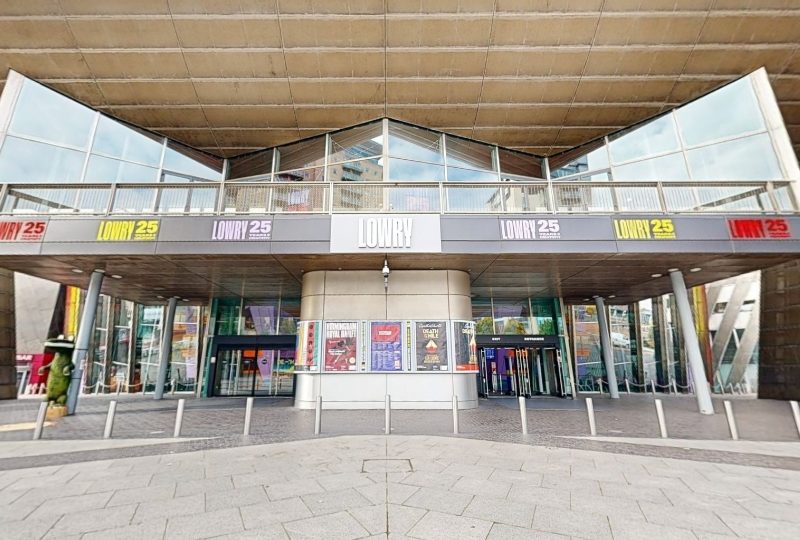
The Lowry’s location immediately shapes how it’s perceived. Sitting directly on the water, the building feels open and outward-facing. The quayside setting gives the venue breathing room, with wide walkways and clear sightlines that make arrival feel unhurried.
There’s no sense of being funnelled into a single entrance or compressed into a narrow approach. Instead, the space around the building allows people to arrive gradually, take in the surroundings, and orient themselves before stepping inside.
The modern architecture reinforces this feeling. Clean lines and broad surfaces reflect the light from the water, giving the building a calm, understated presence rather than a monumental one.
First impressions inside
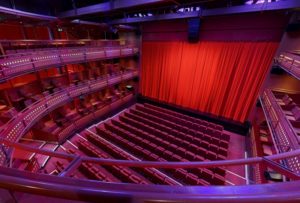
Stepping inside The Lowry, the sense of openness continues. The interior spaces feel generous, with clear lines of sight and a layout that’s easy to read without signage doing all the work.
The main public areas are arranged to encourage movement rather than bottlenecks. You can see where people are heading, where they’re gathering, and where quieter pockets exist. This makes the space feel intuitive even for first-time visitors.
There’s a balance here between scale and comfort. The interior is large enough to accommodate crowds, but it doesn’t feel cavernous. Sound, light, and circulation all feel considered.
A venue designed around movement
One of The Lowry’s defining qualities is how it encourages movement. Walkways, staircases, and open sightlines create a natural flow through the building. You’re rarely forced to stop or double back.
Different levels connect visually as well as physically, so even when you’re moving vertically through the space, you retain a sense of where you are within the building as a whole. This makes the venue feel cohesive rather than fragmented.
Movement here feels purposeful but unpressured. People can pause, watch, or continue on without disrupting others, which gives the venue a steady, calm energy even when it’s busy.
Flexible spaces with clear identities
Although The Lowry is a large venue, its spaces don’t blur together. Theatres, galleries, and public areas each have their own feel and boundaries.
This clarity makes it easy to understand what each space is for and how it’s meant to be used. Transitions between areas are smooth, but distinct enough that the atmosphere changes as you move through the building.
The result is a venue that can host multiple activities at once without feeling chaotic. Different audiences can coexist in the same building while still feeling anchored in their own experience.
Public space that feels genuinely public
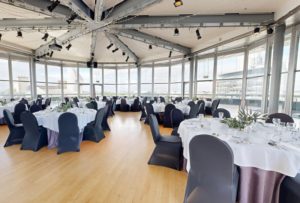
One of The Lowry’s strengths is that its shared spaces don’t feel like corridors between main attractions. The foyers, walkways, and open areas feel like destinations in their own right.
There’s room to pause without being in the way. Seating is positioned where it makes sense, not just where it fits. Sightlines allow you to watch the flow of people without being caught in it. This gives the venue a steady energy rather than a rushed one.
The openness also means the building never feels exclusive or closed off. Even during large events, there are quieter edges and transitional spaces where the atmosphere softens. That balance makes The Lowry feel accessible at different times of day, whether it’s busy with performances or calmer during gallery hours.
It’s a reminder that public space within a venue matters just as much as the headline rooms. When those areas are designed well, the entire building feels more generous and more usable.
Light, views, and atmosphere
Natural light plays a big role in how The Lowry feels. Large windows and open façades connect the interior back to the water and surrounding quays.
This connection prevents the building from feeling enclosed, even deep inside. Views outward provide moments of pause and orientation, reminding visitors of where they are in relation to the wider setting.
As the light changes throughout the day, the mood of the interior shifts subtly, giving the venue a sense of life and variation rather than a fixed atmosphere.
Scale without intimidation
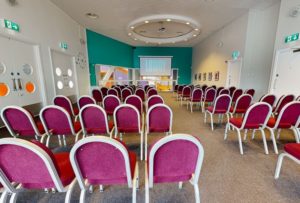
The Lowry regularly accommodates large numbers of people, yet it rarely feels overwhelming. This comes down to how space is distributed.
Crowds spread naturally across different levels and zones rather than concentrating in one place. There’s always somewhere to move to, whether that’s a quieter edge, a viewing point, or a more active central area.
This balance makes the venue feel confident rather than imposing. It can handle scale without relying on heavy direction or control.
A venue that works at different times of day
The Lowry feels different depending on when you experience it, and that variation adds to its appeal.
During the day, natural light from the waterfront gives the interior a calm, open feel. Galleries and public spaces feel relaxed, with room to move and pause without pressure. The building feels accessible and easy to approach.
In the evening, the atmosphere shifts. Artificial lighting sharpens the architecture, reflections from the water become more visible, and the energy builds as people arrive for performances. The foyers feel more animated, but the layout continues to handle the flow comfortably.
What’s notable is that the building doesn’t rely on one fixed mood. It adapts to the time and the activity without losing its identity. Whether it’s hosting a daytime exhibition, a corporate event, or a packed evening performance, the space adjusts without feeling like it’s being forced into a different role.
That ability to feel appropriate at multiple points in the day makes The Lowry more than just a performance venue. It feels like a place that’s consistently in use, rather than only coming to life at specific moments.
Seeing the full layout before visiting
Because The Lowry is made up of multiple levels and interconnected spaces, understanding how it all fits together can take time. To support this, the venue can also be explored through a virtual walkthrough, which allows visitors to move through the building remotely and get a clearer sense of layout before arriving.
Used in this way, the walkthrough supports the in-person experience rather than replacing it, helping people feel oriented before they step inside.
What other venues can take from The Lowry
The Lowry shows how much difference clarity of space makes. By designing around movement, visibility, and flow, the building allows people to use it confidently without needing constant instruction.
This approach applies to many types of venues. When people can read a space easily, they spend less time figuring out where to go and more time engaging with what’s happening there.
Final thoughts
The Lowry works because it’s easy to move through and easy to understand. The building feels open, active, and purposeful without being overwhelming.
Its relationship with the waterfront, its clear internal flow, and the way different spaces coexist all contribute to a venue that feels welcoming at any scale.
As this Featured Tour shows, venues don’t always need dramatic features to make an impression. When space is laid out clearly and experienced properly, it speaks for itself.
At Venue View, that’s exactly what we’re interested in highlighting. The Lowry is a strong example of how thoughtful presentation of space can shape how a venue is understood before anyone even steps inside.